

I’ve been asked for a blog post about how to prepare for the speaking portion of the IELTS test. I’ve been teaching long enough that the request – and the worry that it implied – didn’t exactly surprise me, but I’m always telling my students, and student colleagues (as I have also been a language learner as well) that the speaking portion of the test should really be the least worrisome part of any reasonable and fair non-native language exam. People who haven’t studied a foreign language or have done so on their own and then insist that they can’t actually speak the language; they just understand it, might indeed be given cold sweats at the thought of being tested on their speaking ability.
But it’s not that big of an issue. Any foreign language test – so long as it is indeed reasonable and fair – is just meant to ascertain how well the student can use the language in a spoken setting. Think in terms of your own native language. Could you pass a speaking test in that language designed for non-native speakers? I would certainly hope so! But would you be able to explain the fine points of your language’s grammar in a spoken setting? Maybe not. Probably not, if you’re like most people. (In fact, I’ve had several students in China confidently claim – with 100% confidence! – that their language had no grammar at all!) And that’s what a lot of students worry about.
No, these tests are meant to find out how easily you can handle speaking the target language. Different – but familiar – topics. Did you like school? What was your favorite subject? What are your hobbies? No hobbies? Why is that? These are things that everyone knows the answers to. You shouldn’t even have to think much about them.
Let’s pause for a minute. Click this link and have a look at what exactly the IELTS test is testing, in the speaking section. When you’re done, come back here:
https://ielts-up.com/speaking/ielts-speaking-marking.html
OK. How much of that was grammar? Some, to be sure, but not much. You need to use appropriate tenses; they want to see how good your vocabulary is, and beyond that, they want to hear how well you can understand the tester and how easily the tester can understand you.
Yes, yes, I saw the bit about linking words. Is that grammar? Well, yeah, OK, OK, but really, they only exist to make your ideas clear. Here’s an example:
A: What do you like doing in your free time?
B: I don’t have free time. I like play piano.
That almost makes no sense at all. But how about this:
B: I don’t have much free time, but I like play piano, when I get the chance.
See? The words I highlighted in bold are linking words and phrases and clarifying adverbials, and they make it so much clearer what the student is trying to convey. Is that grammar? Yeah, OK, I’ll cop to that. But it’s pretty natural, or at least it should be.
So how should you prepare for this test? Let’s start with your method of learning the language to begin with. When I took the HSK (The test of Mandarin administered to non-native speakers in China), I had been studying in one-on-one classes, in which classes my teacher and I would discuss many different topics. My textbook itself had a different topic in every chapter (which, by the way, results in my ability to this day to discuss IT technology more intelligently in Mandarin than in English!). But my teacher and I had a policy of no English of any sort in class, ever. This resulted in my having to discuss various ailments and medicines, different surprising things that may have come up from time to time, the weather, personal relationships, our jobs, and how we wound up where we were, and many, many other topics.
This is how a language class should go. Does it interfere with the grammar, vocabulary, etc? Yeah, I guess so, but why exactly am I learning Mandarin (or Spanish, or why are you learning English) in the first place? Speaking in a friendly, relaxed way in a safe atmosphere prepared me very well for my HSK speaking test. I was so well prepared for it that I didn’t even feel as though the speaking test had even begun…until the tester informed me that we were finished. I was disappointed – I’d been having a perfectly pleasant conversation with the tester! I passed the speaking portion of that test almost without knowing that I was taking a test at all.
SO basically, how do you prepare for the IELTS speaking test? Just speak English as much as you can. That’s it! Done! OK, I hope you’ll be back next week!
No enough? Yeah, OK, I do have some suggestions.
The first suggestion, and I think I’ve mentioned my first one a few times already over different posts – have English lessons with a trained, qualified, and experienced English teacher. That teacher will probably lead you through regular, casual conversation. Not too much, of course – there are other things to do in class! But a lot of the time should be in putting you at ease and making the spoken use of English easy and almost second-nature.
Can’t afford a qualified, experienced teacher? Well, some platforms have others to choose from. They have conversation partners. These partners are native speakers, even though they may not be qualified teachers. There are also “Intercambio” sites, where you can find native English speakers who will just have conversations with you, in exchange for giving them the chance to then practice speaking your language.
These are all possible, but there are plenty of other ideas that are actually easier to come by for almost everyone.
* Practice with others who you know can speak English – husbands/wives, boyfriends/girlfriends, etc. Casual friends and so on. A lot of my students say they are embarrassed to speak English with these people. OK…get over it! You have a test to pass! If you’re too embarrassed to talk to people you know, how much harder will it be to speak with your tester??
- Join or make an English corner.
English Corners are popular all over China. They come in all sizes, from just two people who want to practice together to entire city-wide weekly events. People will go to the main square in the city, and everyone is welcome…but they have to speak English! Talk about whatever you want. Just go there to make friends. Whatever. But speak English.
You can form one, yourself. You just need one other person, but the more, the merrier. Ask a local café if they wouldn’t mind hosting that for an hour or two every week. They will not mind! Just pick a time and day that isn’t so busy and they’ll welcome the customers. Or go to a park, or anywhere. Only one rule – speak English.
- Make a speaking game – a speech game of speaking for five minutes on an unprepared topic:
https://ieltsliz.com/ielts-speaking-part-1-topics/
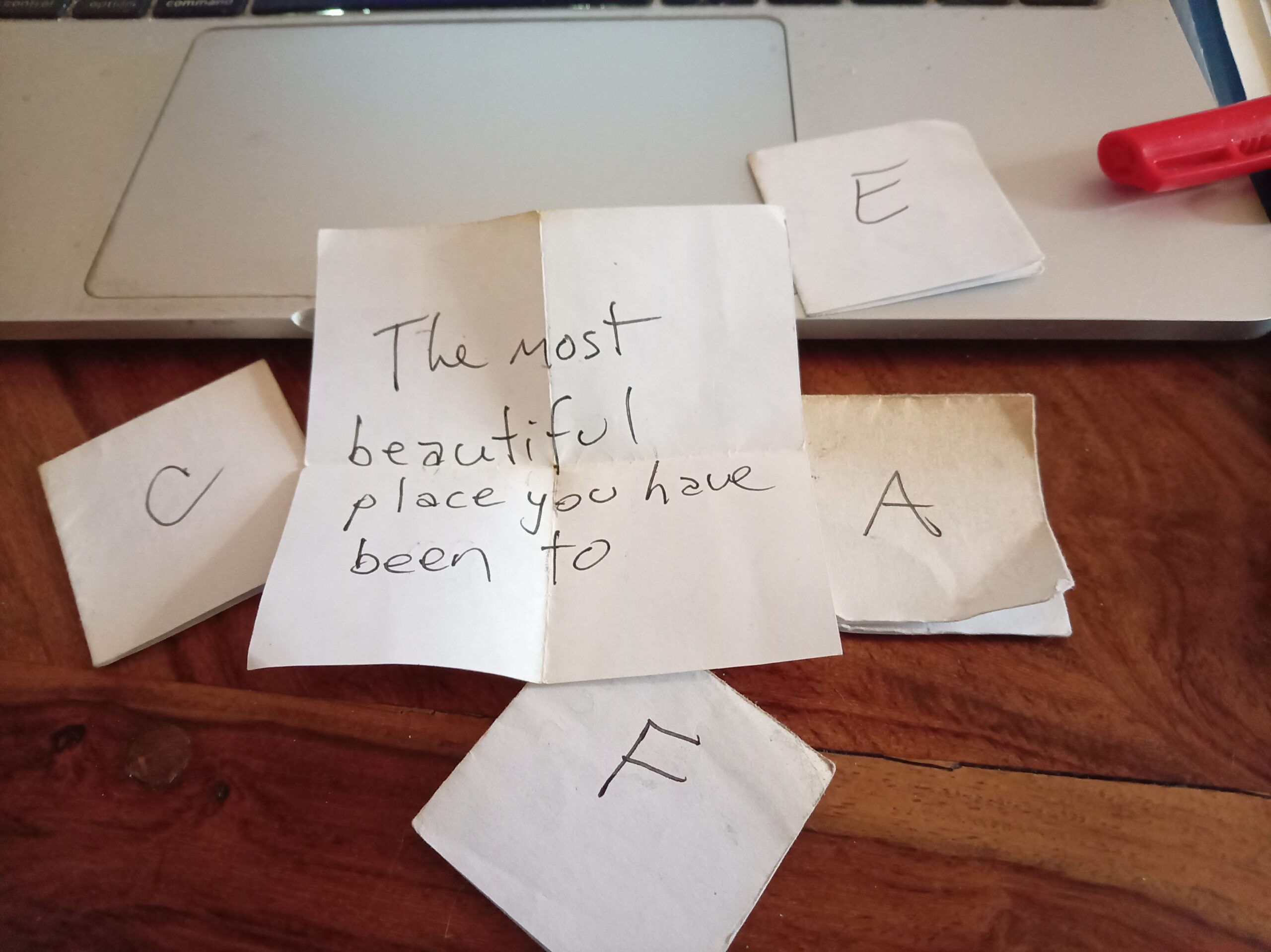
The game works like this: You take small, 3-4cm square pieces of paper. On the paper, write a topic. I have one in front of me. Unfolded, it says, “What you’d like to learn and why”. You now have to talk about that for five minutes. Then it’s the next person’s turn: “What has been your greatest achievement so far?” And so on and on. This is great practice. Make sure that none of the topics require specific previous knowledge. This is similar to the IELTS speaking section 1. This is a problem for many people, because of this next piece of advice:
- Know Yourself! SO MANY of my students, when given a question like, what was your best/favorite subject at school (for example), the answer is far too often – I don’t know / I’ve never thought about it. Well, think about it NOW. What do you believe? Why? Do you think the Americans really landed on the moon, or was that a hoax? I know you don’t know whether it was real or fake, but that’s not the question. The question is, what do you think? Do you prefer dogs or cats? How do you feel about cold/hot weather? If you don’t know what you think / prefer / how you feel, English is not your biggest problem! The IELTS testers probably won’t give you anything too controversial (but you can’t be sure!), but they will definitely ask your opinions, so you need to have some, and be prepared to answer the dogs or cats question with more than “I don’t know.” That’s just not enough. Better yet, “Oh, I don’t have a preference. I love them both, though cats are usually easier to take care of. They’re more independent, aren’t they?” That’s not enough either, but it’s a great start and far superior to I don’t know.
- Record yourself speaking English and listen back. This is fantastic practice; while you’re speaking, you’re concentrating on what you say. When you listen back, you can focus on how you sound.
These are all fantastic ways to practice your English anyway. But if you’re scheduled to take an IELTS test, you need to have practice, and you need to start practicing long before you schedule the test!
Let me know in the comments which of these suggestions, if any, were the most helpful. Good luck!